Sign up for our free newsletter and you'll be amongst the first to receive insightful Delaware-focused economic and policy updates.
FOR IMMEDIATE RELEASE
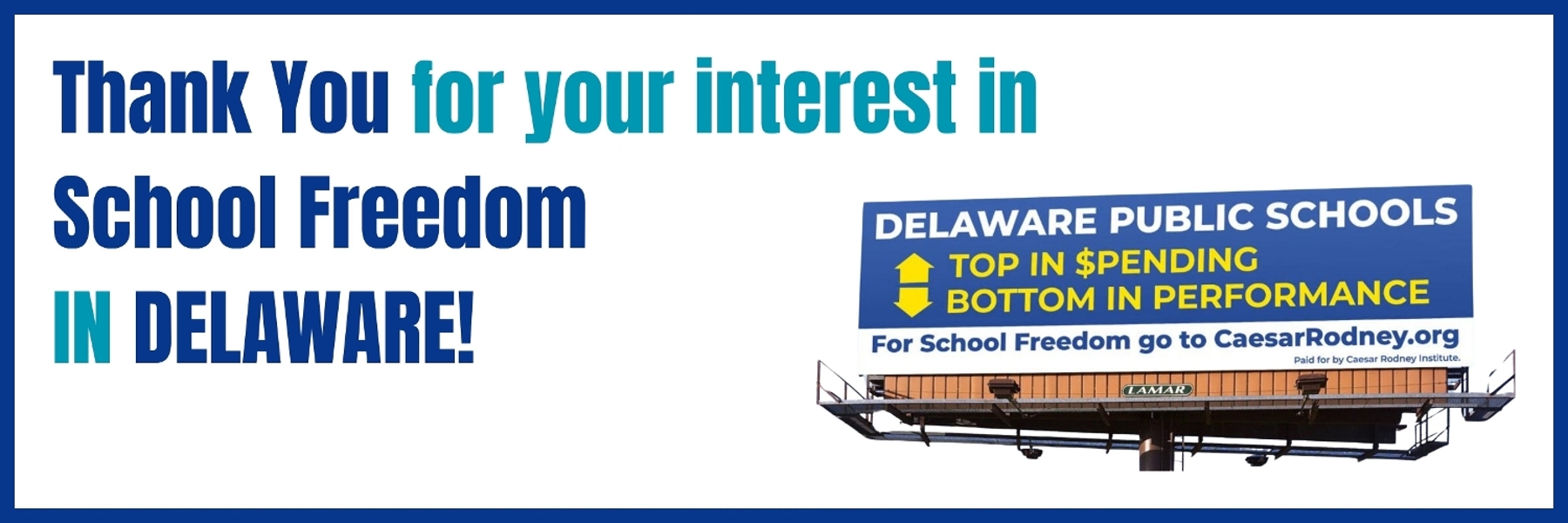
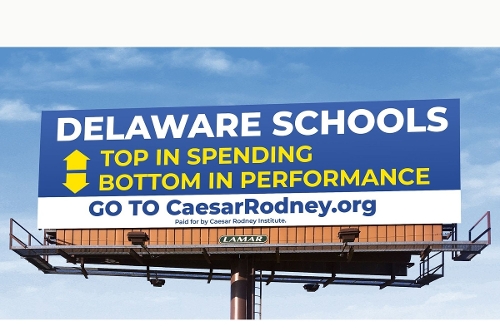
School Freedom Billboard Initiative Sparks Urgent Call for Education Reform in Delaware
(Newark, DE., March 28, 2024)-The Caesar Rodney Institute (CRI) announces the launch of the School Freedom Billboard Initiative, a groundbreaking campaign to raise awareness and spark action to improve education performance in Delaware. The initiative's billboard, now prominently displayed on Interstate 95 south of Wilmington, DE, seeks to rally parents and community members to demand better educational outcomes for their children.
"The School Freedom Billboard Initiative serves as a visual reminder
...
Read More
Our legislature's approach to promoting offshore wind power raises serious concerns about deception and manipulation.
By David T. Stevenson
Center for Energy & Environmental Policy
April 5, 2024
Delaware lawmakers have cleverly disguised the costly price of offshore wind power through a draft Senate bill called the "Energy Solutions Act." This bill is a prime example of how to deceive Delawareans and the public by making it seem like a "noble" effort through skillful wording and selective data.
Let's start by first examining the title of the draft Senate bill. They cleverly chose the title "Energy S...
Read More
FOR IMMEDIATE RELEASE April 16, 2024 Caesar Rodney Institute Releases 2nd Annual 'Delaware Report Card' on Governance (CLICK HERE to view the report card.) NEWARK, DE--The Caesar Rodney Institute (CRI) announces the release of its 2023 "Delaware Report Card," marking the second year of its review in key areas of governance crucial for a strong and sustainable economy. These key areas include Business Taxes, State Economy, State Government Finance, Education, Environment, Energy, and Healthcare. The report card was rigorously graded by CRI's team of policy experts, which inclu...[read more]
Navigating Reform: Legislative Priorities to Improve Delaware K-12 Education Charting a path to excellence in the state's education system By Dr. Tanya Hettler,PhD, Director Center for Education Excellence March 21, 2024 Despite Delaware's significant investment in K-12 education, student performance in math and English language arts (ELA) has not improved over the past two decades. With per pupil spending ranking among the highest in the nation, we must reevaluate our approach and prioritize meaningful reforms to improve educational outcomes. In response to this pressing challenge, we recommend the ...[read more]
Go West young Delaware techie... CA, OR, & WA receive almost 20% of Delaware's net outbound migration. By Charlie Copeland, Director Center for Analysis of Delaware's Economy & Government Spending January 26, 2024 Our previous analyses discuss Delaware's inbound migration of retirees from our regional neighbors (PA, NJ & MD) and outbound migration to the more prosperous Southeast (FL, TX & NC). This final analysis in the "Migration Series" focuses on outbound migration to the West Coast. Despite a decade of significant population loss, California is the recipient of a large portion o...[read more]
Delaware Schools Need Accountability, Not More Money By Dr. Tanya Hettler, PhD Center for Education Excellence January 5, 2024 On Monday, December 12th, 2023, the Delaware Department of Education(DDOE) released an Education Funding Study that cost taxpayers $700,000. This study was produced by the American Institutes for Research(AIR) as part of the State's required response to a lawsuit filed by the American Civil Liberties Union (ACLU) and other groups in 2018 to improve equity in Delaware's K-12 schools. Before we analyze this costly study obtained by the State, let'...[read more]